Is LASIK Safe? What To Know About Risks, Screening, And Long-Term Results
Is LASIK safe? For many properly screened adults, LASIK has a strong safety record and high satisfaction, but it is still eye surgery and not the right choice for every patient. Safety depends on your eye health, corneal shape, tear film, prescription stability, expectations, and whether your surgeon recommends LASIK or another vision correction option.
At Wellish Abrams Vision Institute in Las Vegas and Henderson, Nevada, aLASIK consultation is designed to answer one essential question first: Is LASIK a safe procedure for your eyes?
The Evidence-Based Answer
LASIK is one of the most studied elective eye procedures. Research generally supports LASIK as safe and effective for properly selected candidates, but the best answer is not “yes for everyone.” The better answer is: LASIK can be safe when screening confirms that your eyes are a good match and you understand the possible side effects.
The FDA’s LASIK Quality of Life Collaboration Project found that more than 95% of participants were satisfied with their vision after LASIK. The same project also reported that some patients developed new visual symptoms, most often halos, and some reported dry eye symptoms after surgery. That is why a good LASIK evaluation should discuss both outcomes and risks in plain language.
What LASIK Does To Improve Vision
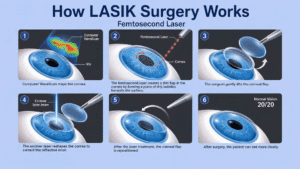
LASIK eye surgery corrects common refractive errors by reshaping the cornea, the clear front surface of the eye. When the cornea focuses light more accurately, many patients can see more clearly with less dependence on glasses or contact lenses.
LASIK may treat nearsightedness, farsightedness, and astigmatism in adults who meet candidacy requirements. It does not prevent every future change in vision. Presbyopia, cataracts, dry eye, glaucoma, and other eye conditions can still develop with age, even after successful LASIK.
Why Screening Matters So Much
A LASIK consultation is not just a sales appointment. It is a safety checkpoint. Two people may have similar prescriptions but completely different corneal thicknesses, tear quality, intraocular pressure, pupil sizes, medical histories, or lifestyle needs.
During the evaluation, your care team may review your medical history, measure your prescription, perform corneal mapping, check your intraocular pressure, and evaluate your tear film. Wellish Abrams Vision Institute’sLASIK consultation guide explains how this visit helps determine whether LASIK, photorefractive keratectomy, EVO ICL, refractive lens exchange, or another option may be a better fit for your eyes.
Before scheduling, patients can also start with theLASIK candidacy quiz. The quiz does not replace an exam, but it can help you understand whether a consultation makes sense.
Common LASIK Risks And Side Effects
Most LASIK side effects improve as the eyes heal, but they still matter. Patients should know what can happen before deciding.
Dry eyeis one of the most common concerns. LASIK can temporarily affect tear production and corneal nerve signaling, which may cause burning, grittiness, fluctuating blur, or irritation. If you already have dry eye, your doctor may recommend treating the ocular surface before surgery or considering a different procedure.
Some patients notice glare, halos, starbursts, light sensitivity, or difficulty with night driving, especially during early healing. The FDA notes that even with good vision on a standard eye chart, some patients may not see as well in low-contrast conditions, such as at night or in fog.
Other possible issues include undercorrection, overcorrection, regression, infection, inflammation, flap-related complications, or the need for glasses, contacts, or enhancement surgery. Serious complications are uncommon but possible, which is why screening and follow-up care matter.
Who May Not Be A Good LASIK Candidate
LASIK may not be recommended if the risk profile is too high. Your surgeon may suggest waiting or choosing another option if you have:
Not being a LASIK candidate does not always mean you are out of options. Wellish Abrams Vision Institute offersLASIK alternatives, includingEVO ICL andrefractive lens exchange, for some patients whose eyes may not be ideal for LASIK.
What Long-Term Results Can Look Like
For the right candidate, LASIK can provide long-lasting distance vision improvement. Long-term studies of LASIK and photorefractive keratectomy generally report strong safety and effectiveness for appropriately selected patients, especially when treatment stays within recommended ranges.
Still, LASIK does not freeze your eyes in time. Reading vision often changes after 40 due to presbyopia. Cataracts can develop later in life. Some patients may need glasses for certain tasks, and a smaller number may need an enhancement if their vision changes.
The best long-term mindset is simple: LASIK can reduce dependence on glasses or contacts, but regular eye exams still matter.
Safer LASIK Starts With Clear Expectations
A safe LASIK experience starts before the procedure. You should understand your candidacy, risks, expected recovery, costs, and alternatives. If LASIK is recommended, your team will explain what to expect before and after surgery. If you want more details before your visit, read aboutpost-LASIK surgery expectations andLASIK pricing.
Schedule A LASIK Consultation In Las Vegas Or Henderson
If you are wondering whether LASIK is safe for your eyes, the next step is not guessing. Wellish Abrams Vision Institute provides LASIK consultations for patients in Las Vegas, Henderson, and nearby Southern Nevada communities.Request a LASIK consultation to learn whether LASIK, photorefractive keratectomy, EVO ICL, refractive lens exchange, or another option is the best fit for your eyes and goals.
FAQ: Is LASIK Safe?
LASIK can be safe for properly screened adults, but it is not right for everyone. Your safety depends on your prescription, corneal thickness, corneal shape, tear film, eye health, medical history, and expectations.
Common LASIK side effects may include dry eye, glare, halos, starbursts, light sensitivity, fluctuating vision, or mild irritation during healing. Many symptoms improve over time, but some patients may need additional treatment or follow-up care.
Yes. LASIK can cause or worsen dry eye symptoms, especially in the early healing period. Patients with existing dry eye may need treatment before surgery or may be better suited to another vision correction option.
Serious LASIK risks are uncommon but can include infection, inflammation, corneal flap complications, reduced vision quality, persistent dry eye, or vision symptoms that affect night driving and daily activities. Your surgeon should discuss these risks before surgery.
A LASIK consultation improves safety by checking whether your eyes meet candidacy requirements. Testing may include prescription measurement, corneal mapping, corneal thickness measurement, eye pressure testing, tear film evaluation, and a full review of your health history.
LASIK permanently reshapes the cornea, but your eyes can still change over time. Presbyopia, cataracts, dry eye, glaucoma, and natural shifts in prescription can still affect vision later in life.
If you are not a LASIK candidate, your doctor may discuss options such as photorefractive keratectomy, EVO ICL, refractive lens exchange, glasses, or contact lenses. The safest choice depends on why LASIK is not recommended.
Wellish Abrams Vision Institute provides LASIK consultations for patients in Las Vegas, Henderson, and nearby Southern Nevada communities. A consultation can help determine whether LASIK is safe for your eyes or whether another vision correction option may be a better fit.
Related Posts
Schedule Your Eye Exam Today
If blurry vision, eye strain, changing prescriptions, dry eyes, or trouble seeing clearly is affecting your daily life, it may be time to schedule a comprehensive eye exam. Wellish Abrams Vision Institute provides eye care for patients in Las Vegas, Henderson, and nearby Southern Nevada communities.
To provide the best experiences, we use technologies like cookies to store and/or access device information. Consenting to these technologies will allow us to process data such as browsing behavior or unique IDs on this site. Not consenting or withdrawing consent, may adversely affect certain features and functions.
Functional
Always active
The technical storage or access is strictly necessary for the legitimate purpose of enabling the use of a specific service explicitly requested by the subscriber or user, or for the sole purpose of carrying out the transmission of a communication over an electronic communications network.
Preferences
The technical storage or access is necessary for the legitimate purpose of storing preferences that are not requested by the subscriber or user.
Statistics
The technical storage or access that is used exclusively for statistical purposes.The technical storage or access that is used exclusively for anonymous statistical purposes. Without a subpoena, voluntary compliance on the part of your Internet Service Provider, or additional records from a third party, information stored or retrieved for this purpose alone cannot usually be used to identify you.
Marketing
The technical storage or access is required to create user profiles to send advertising, or to track the user on a website or across several websites for similar marketing purposes.