So I was told I am not a LASIK candidate, now what? Around 800,000 Americans undergo laser vision correction surgeries each year. These elective procedures correct common vision problems, such as nearsightedness and farsightedness. Some people never need to wear contact lenses or glasses again after surgery. Others may eventually need reading glasses or other corrective vision devices, but still have improved eyesight.
Approximately 80% to 85% of people who undergo laser eye surgeryopt for LASIK. This popular procedure has become a household name thanks to enthusiastic marketing campaigns by national chains. You can find LASIK advertisements in magazines, TV commercials, and radio shows. However, not everyone is an ideal candidate for LASIK. This guide explores the history of LASIK, debunks common myths, and outlines the qualifications required for this surgery.
What Is LASIK and How Does it Work?
LASIK is an abbreviation for Laser-Assisted In Situ Keratomileusis. This surgery uses a gently pulsing laser to reshape the cornea, allowing light to enter the eye at a different angle. This minor correction can eliminate imperfections in your eye and improve your vision.
Eye doctors use LASIK to correct several common refractive errors, including:
Myopia (nearsightedness): This occurs when you have an abnormally long eyeball or a steeply curving cornea. As a result, incoming light rays focus in front of the retina, and faraway objects look blurry.
Hyperopia (farsightedness): It is characterized by a short eyeball or flat cornea. These structures cause light to focus behind the retina, so objects that are near appear blurry.
Astigmatism: This eye condition happens when the cornea has an uneven curvature, affecting both near and far vision.
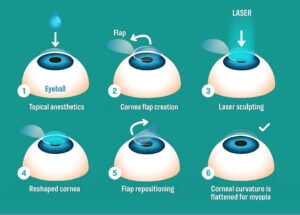
LASIK for astigmatism, myopia, and hyperopia involves the same basic steps:
Comprehensive Exam: You’ll receive an initial evaluation to determine if you’re a good candidate for LASIK. During this appointment, the eye doctor will measure the curve of your corneas and pupils. They’ll also take your medical history and check for any active eye conditions, such as cataracts. These assessments help them evaluate your health and determine the amount of corneal tissue to be removed during the procedure.
Eye Numbing: Your surgeon and their team will help you feel comfortable in the operating room and apply numbing drops to your eye. You may also receive a mild sedative.
Flap Creation: The LASIK surgeon uses an advanced laser to create a flap in the cornea and gently lift it.
Cornea Sculpting: A cutting laser removes tiny amounts of tissue from your cornea to sculpt it into a new shape.
Flap Replacement: The surgeon places the cornea flap back in its regular position at the end of the procedure.
Corrective eye surgery may sound intimidating or horrifying if you’re not an eye doctor. However, rest assured: LASIK is a quick, low-risk, and virtually painless procedure. It also has a remarkably high success rate. Over 95% of LASIK patients were satisfied with their eyesight after the surgery.
The Evolution of LASIK Technology
Laser eye treatment has a long history. In 1885, Hjalmar Schiotz first proposed reshaping the cornea to correct vision conditions. In 1939, Tsutomu Sato began using radial keratotomy to flatten the cornea and correct nearsightedness (myopia). LASIK technology continued to evolve steadily throughout the twentieth century as surgeons developed increasingly sophisticated lasers.
In 1999, LASIK surgery reached a critical milestone when it received approval from the Food and Drug Administration (FDA). The approved treatment reshaped the cornea with an excimer laser. Several years later, LASIK surgeons began using femtosecond laser technology to increase precision. In 2016, the FDA approved topography-guided ablation, which has been shown to yield better patient outcomes.
Common Misconceptions About LASIK Eye Surgery
There are many myths and misconceptions about LASIK and other vision correction procedures, such as:
LASIK doesn’t hurt: Your surgeon will place numbing drops in your eye to ensure you won’t feel any pain during laser eye surgery. After the procedure, you may experience mild discomfort, itching, or burning as your eyes heal.
LASIK wears off: This procedure permanently reshapes the surface of your eye, so it doesn’t fade away. However, it’s normal for vision to change over time due to the natural aging process or eye diseases. You may need additional laser eye surgery or reading glasses in the future.
LASIK is dangerous: No medical procedure is totally risk-free, but complications occur in less than 1% of LASIK surgeries.
Qualifications for LASIK: Who Is an Ideal Candidate?
Who is a candidate for LASIK? Eye doctors use several factors to determine whether this procedure suits you.
Age Considerations
According to the FDA, the age limit for LASIK surgery is 18 and older. However, many eye doctors don’t recommend LASIK for people in their early 20s because their eyesight can still change quickly at this age.
Currently, there is no maximum age limit for LASIK candidates; however, many eye clinics, such as Wellish Vision, often recommend LASIK for individuals under 45.
Eye Health Conditions
Surgeons typically don’t recommend refractive eye surgery for people with certain eye conditions, including:
You don’t need terrible vision to qualify for LASIK. However, a stable prescription is one of the most essential requirements for LASIK. You must have no contact lenses or changes to your prescription for at least 1 year before undergoing LASIK, as refractive instability can increase the risk.
Corneal Thickness and Pupil Size
Your LASIK surgeon will measure the thickness of your cornea during your initial evaluation to ensure that you’ll have enough tissue left over after the procedure. They’ll also measure your pupils. People with large pupils may have more visual symptoms immediately following surgery, but they can still undergo LASIK successfully.
Talk to an Expert Today and Get Your LASIK or a LASIK Alternative
Who is not a candidate for LASIK? Many factors, including corneal thinness and eye conditions, can make you an unsuitable candidate for this procedure. But don’t worry: If you don’t meet the requirements for LASIK, you’re not doomed to wear glasses or contacts forever. Wellish Abrams Vision Institute offers LASIK and cutting-edgeLASIK alternatives, including refractive lens exchange and implantable collamer lenses. Each of these procedures has various pros and cons. For instance, people who receive refractive lens exchange will never get cataracts.
Our compassionate and skilled team will educate you about your options and help you choose the best treatment to improve your eye health. Call us today or schedule a LASIK consultation online.
FAQ: So I Was Told I Am Not a LASIK Candidate
It means your eye doctor found something about your eyes, your prescription, or your overall eye health that makes LASIK less safe or less likely to give you the best results. That does not automatically mean you are out of vision correction options; it just means LASIK may not be the right fit for you right now.
Common reasons include dry eye syndrome, corneal disease, active eye infection, optic nerve disease, severe cataracts, an unstable prescription, or corneas that are too thin for safe reshaping. Your doctor may also look closely at pupil size and other measurements during your evaluation.
Sometimes, yes. If the issue is temporary, such as dry eye, an active eye problem, or a prescription that has not been stable long enough, you may be able to qualify later after treatment or more time. If the reason is structural, such as thin corneas or certain eye diseases, your doctor may recommend a different procedure.
Yes. The blog notes that LASIK is approved for adults 18 and older, but many eye doctors prefer to wait until vision has stabilized, which is why early 20s patients are sometimes asked to hold off. It also notes that there is no strict maximum age limit, though practices often recommend LASIK for patients under 45.
Not necessarily. Larger pupils may increase the chance of certain visual symptoms after surgery, especially early on, but they do not automatically rule you out. Your surgeon will measure your pupils as part of your LASIK evaluation and explain whether they affect your candidacy.
You may still have other vision correction options. The article specifically points to LASIK alternatives offered by Wellish Abrams Vision Institute, including refractive lens exchange and implantable collamer lenses. The best choice depends on your prescription, eye anatomy, age, and long-term vision goals.
The best next step is a LASIK consultation or a comprehensive eye evaluation. During that visit, your doctor can measure your corneas and pupils, review your prescription history, check for other eye conditions, and walk you through the option that best fits your eyes, whether that is LASIK or a LASIK alternative.
Related Posts
Schedule Your Eye Exam Today
If blurry vision, eye strain, changing prescriptions, dry eyes, or trouble seeing clearly is affecting your daily life, it may be time to schedule a comprehensive eye exam. Wellish Abrams Vision Institute provides eye care for patients in Las Vegas, Henderson, and nearby Southern Nevada communities.
To provide the best experiences, we use technologies like cookies to store and/or access device information. Consenting to these technologies will allow us to process data such as browsing behavior or unique IDs on this site. Not consenting or withdrawing consent, may adversely affect certain features and functions.
Functional
Always active
The technical storage or access is strictly necessary for the legitimate purpose of enabling the use of a specific service explicitly requested by the subscriber or user, or for the sole purpose of carrying out the transmission of a communication over an electronic communications network.
Preferences
The technical storage or access is necessary for the legitimate purpose of storing preferences that are not requested by the subscriber or user.
Statistics
The technical storage or access that is used exclusively for statistical purposes.The technical storage or access that is used exclusively for anonymous statistical purposes. Without a subpoena, voluntary compliance on the part of your Internet Service Provider, or additional records from a third party, information stored or retrieved for this purpose alone cannot usually be used to identify you.
Marketing
The technical storage or access is required to create user profiles to send advertising, or to track the user on a website or across several websites for similar marketing purposes.